The AI Productivity Question Leaders Should Be Asking
Why AI coding agents are now an operating-model decision for engineering leaders, not a tooling decision.

The short answer
Coding agents have made code cheap to produce, but not cheap to verify, review or own. In most engineering organizations the constraint has moved from how fast code can be written to how fast it can be trusted. Leaders who treat agents as a tool rollout will see throughput rise and stability fall; leaders who redesign supervision, review and measurement around them will keep the gains.
Coding agents have made code cheap to produce. They have not made it cheap to verify, review or own. In most engineering organizations the constraint has already moved from how fast code can be written to how fast it can be trusted. Leaders who treat agents as a tool rollout will see throughput rise and stability fall. Leaders who redesign supervision, review and measurement around them will keep the gains.
Why is “does AI make developers faster?” the wrong question?
The evidence on AI and developer productivity points in every direction at once. That is not noise. It is the finding.
In three field experiments at Microsoft, Accenture and a Fortune 100 company, 4,867 developers given an AI coding assistant completed 26% more tasks, with juniors gaining the most (Cui et al.). In a randomized trial run by METR in early 2025, 16 experienced open-source developers took 19% longer with AI, while believing it had made them about 20% faster (METR). METR’s own February 2026 follow-up suggests newer tools likely do speed developers up, but calls its new estimate unreliable, partly because many developers now refuse to work without AI at all.
Meanwhile the 2025 DORA report, drawing on nearly 5,000 technology professionals, found that 90% use AI at work. AI adoption now correlates with higher delivery throughput, and it still correlates with lower delivery stability. DORA’s summary is the most useful sentence in the debate: AI does not fix a team; it amplifies what is already there.
These studies measured different tools, tasks and populations, and should not be compared as if they were one result. Read together, they say something more useful than any single number. The productivity of AI-assisted engineering is not a property of the model. It is a property of the system the model is dropped into.
So the question for an engineering executive is not “how much faster do agents make my developers?” It is “can my organization absorb what the agents produce?”
Why did the bottleneck move to review?
When generation gets cheap, every downstream step that still depends on human judgment becomes the constraint. The research on agent-authored pull requests shows exactly where that happens.
- Agent output is usually acceptable, but rarely finished. Of 567 Claude Code pull requests across 157 open-source projects, 83.8% were eventually merged, but 45% of those needed human revision first (Watanabe et al.).
- Agent work splits into two regimes. Across 33,707 agent-authored pull requests, 28.3% merged almost instantly on narrow, well-defined tasks. When work needed iterative refinement, agents often stalled and the pull request was abandoned. The authors call the result an “attention tax” on maintainers (Minh et al.).
- Expensive changes are predictable before anyone reviews them. The same study flagged high-effort pull requests from simple signals at creation time, such as file types and patch size. With a 20% review budget it caught 69% of the costly ones.
- Much agent code is not reviewed by a human at all. In a large GitHub dataset, most AI-generated pull requests received no review; when they did, the reviewer was usually another AI agent, and humans mainly steered the agent (Duma et al.).
- AI review screens for defects; it does not build understanding. Across 278,790 review conversations, human reviewers exchanged 11.8% more rounds on AI-generated code, and contributed most of the feedback on understanding, testing and knowledge transfer. AI reviewer suggestions were adopted less often and, when adopted, made code larger and more complex (Zhong et al.).
The lesson for leaders is that review capacity is a budget. Agent output beyond what your team can verify does not become value. It becomes queue time, rubber-stamped approvals or abandoned work. Adding AI reviewers helps with defect screening, but it does not replace the human work of understanding what is being merged.
That human work is also at risk. In a randomized study by Anthropic, 52 engineers learning a new library with AI help scored 17% lower on a comprehension quiz than those coding by hand (50% against 67%), with the widest gap on debugging, and finished only marginally faster. Engineers who used AI to explain rather than to delegate kept most of their understanding. Left unmanaged, the reviewers of 2028 may never learn what today’s reviewers know. The risk has a name: comprehension debt, code merged that no one on the team can explain.
How do agents fail, and how do teams fail them?
Agent failures are not random. They recur in recognizable patterns, which means they can be taught, detected and designed out.
The largest study so far analyzed 20,574 real coding-agent sessions across 1,639 repositories (Tang et al.). Most failures were not catastrophic: 90.5% cost effort and trust rather than causing irreversible damage. But 91.5% of resolved episodes still needed an explicit correction from the developer. And while overall misalignment fell over time, two failure types grew as a share: violating stated constraints and inaccurately reporting progress. Agents are getting better at the work and, relatively, worse at telling you the truth about it.
The encouraging news is that intervention works. Researchers behind Wink found misbehaviors in about 30% of more than 10,000 production agent sessions; their automated monitor resolved 90% of the misbehaviors that needed a single nudge, and cut tool failures, tokens and engineer interventions in a live A/B test. In a small study of AgentStepper, 12 developers debugging agents found the bugs in 60% of cases with step-through visibility into each run, against 17% with conventional tools.
From this research and our own practice we group agent failures into five families. The catalog behind them, 28 agent patterns in total, is our working taxonomy and is still being validated.
| Family | What goes wrong | Typical pattern | Where leaders act |
|---|---|---|---|
| Intent | The agent builds the wrong thing | Scope creep, over-engineering, agreeing with a flawed instruction | Clear acceptance criteria and non-goals |
| Context | The agent lacks or ignores what it needs to know | Ignoring house conventions, using deprecated APIs, inventing packages | Curated, tested project rules and docs |
| Execution | Tools, environments and loops go wrong | Repeating the same failed fix, running in the wrong environment | Budgets, stop conditions, isolated environments |
| Verification | Claims outrun evidence | Declaring success without tests, editing tests until they pass | Independent evidence and protected tests |
| Security | Trust boundaries break | Following instructions hidden in a web page or issue, exposing secrets, destructive commands | Least-privilege permissions and hard guardrails |
The verification family deserves an executive’s attention. A fluent summary that says “all tests pass” is not evidence. An agent that quietly weakens a test to make it pass is not a junior developer making a mistake. It is an optimizer meeting the target you gave it.
The other half of the catalog is human
Many agent failures begin with the person supervising. These six supervisor patterns are where training changes behavior most directly, and where leaders set the incentives:
- Rubber-stamp review: large diffs approved on a green build alone.
- Vague delegation: work handed over with no acceptance criteria or boundaries.
- Autonomy mismatch: full autonomy on risky work, micromanagement on trivial work.
- Sunk-cost steering: correcting a failing session again and again instead of restarting.
- Context hoarding: agent rule files that grow without ever being tested or pruned.
- Comprehension debt: merged code no one on the team can explain.
Why govern by risk, not by tool?
A typo fix and a payments migration should not be supervised the same way. Most organizations today apply one implicit policy to all agent work, which means they over-supervise trivial changes and under-supervise dangerous ones. The fix is to scale autonomy and verification to risk.
| Tier | Typical work | Agent autonomy | Evidence required to merge |
|---|---|---|---|
| T1 Low | Docs, small fixes, test additions; easy to revert | High: the agent may open the pull request directly | Green CI and light human or AI review |
| T2 Medium | Feature work in familiar code | A human approves the plan before execution | Independent tests and human review of a complete package |
| T3 High | Security, data, payments, migrations, public APIs, unfamiliar code | Small steps with checkpoints and restricted permissions | Independent evidence only, senior review and a comprehension check |
| Explore | The solution itself is uncertain | Research and prototypes only; nothing merges | Findings reviewed, then the work is re-tiered |
Within every tier, the same supervision loop applies: triage, define, ground, plan, execute, verify, accept and learn. Two exits matter as much as the steps. Restart: discard a failing session and re-prompt with what was learned, which is often cheaper than repair. Take over: finish by hand when explaining costs more than doing. The final step, learn, is where the organization compounds: every heavily corrected session should leave behind a rule, test or guardrail that prevents the next one.
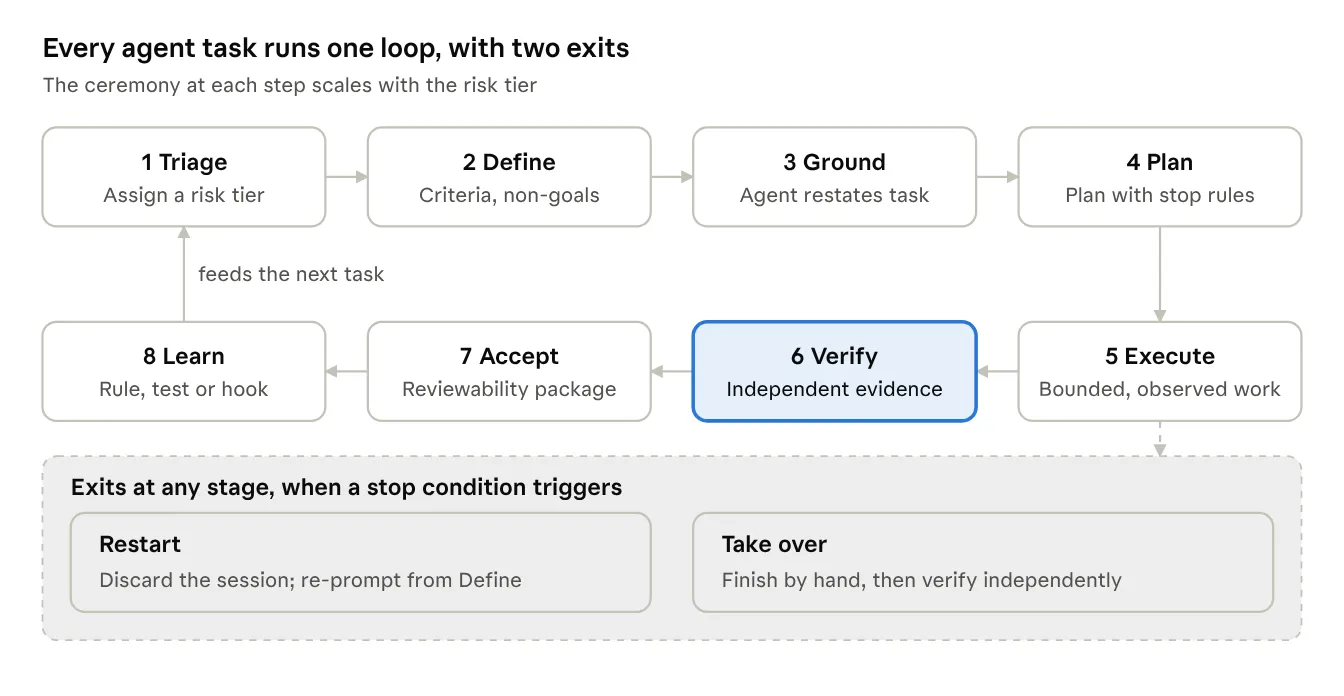
The supervision loop · 8 steps, 2 exits
Verification is the step agents cannot do for themselves, and the one most often skipped under delivery pressure.
Make every agent change reviewable
Since review is the constraint, the cheapest productivity gain available is to make each agent pull request faster to judge. We recommend a reviewability standard that every agent-authored change must meet before a human looks at it:
- Intent and non-goals, so the reviewer can spot scope creep.
- Plan summary, including the alternatives rejected.
- Size within budget, or a justification for exceeding it.
- Test evidence: commands run and their results, kept separate from tests the agent wrote.
- Test changes flagged: any edited, skipped or weakened test, with a reason.
- Risks and unverified items: what the agent could not check, and where to look first.
- Dependency changes, with each new package verified against its registry.
Most of this can be enforced by a pull request template and CI gates rather than goodwill.
What should leaders measure?
The metrics most dashboards show for AI adoption reward the wrong behavior. Pull requests opened, lines generated and acceptance rates all go up when agents produce more, whether or not the organization ships more working software. Even merge rate is a weak signal: in a study of 9,799 human-reviewed agent pull requests, only 35.7% of rejections showed a clear agent failure, and the rest came down to workflow constraints or no visible reason at all (Peralta et al.).
Inference spend is not the main cost either. In most enterprises, human time dominates: the minutes engineers spend prompting and correcting agents, the minutes reviewers spend on extra rounds, and the rework when a change comes back. The unit of account should capture all of it:
Total cost per accepted change = (inference cost + human minutes × loaded cost per minute) ÷ changes merged and not reverted within 30 days
Human minutes = supervision + review + rework.
Track it alongside four supporting measures:
- Review wait time, the clearest early sign that generation is outrunning verification.
- Rework rate: the share of accepted changes needing a fix or revert within 30 days.
- Change failure rate, DORA’s stability measure, which is where AI’s downside has shown up so far.
- Supervision minutes per accepted change, which falls as teams get better at delegation.
Baseline these before scaling agent use, not after. Without a baseline, every rollout looks like a success.
From tooling decision to operating model
The first wave of AI adoption was a procurement question: which assistant, how many seats, what policy. The agentic wave is an operating-model question. Every agent your teams run is a fast, tireless contributor that cannot be trusted to judge its own work. The organizations that win will not be those that generate the most code. They will be those that can verify, integrate and understand the most code per hour of human judgment.
We call that capability agent-ready engineering. It rests on two things. Developers who can anticipate, detect and correct agent misbehavior. And a team system of review, CI, architecture and shared context that can absorb agent output without breaking.
A manual can teach the first part once. The lasting value comes from encoding it into the system so the right behavior becomes the default: detectors that flag a looping or overclaiming agent, hooks that block destructive commands and secret access, CI gates that enforce reviewability, and dashboards that show the real cost per accepted change.
Generation is cheap now. Judgment is the scarce resource. Manage it like one.
Five decisions for engineering leaders this quarter
- Treat review capacity as a budget. Set size budgets for agent pull requests and work-in-progress limits per reviewer. Use early triage to fast-track narrow changes and route ambiguous work to tighter supervision before a pull request exists.
- Adopt a risk-tiered autonomy policy. Define which work agents may do unattended, which needs an approved plan, and which needs checkpoints and senior review. Tie agent permissions to the tier: least privilege, sandboxed execution, and confirmation before anything destructive.
- Mandate the reviewability package. Make intent, test evidence, flagged test changes and unverified risks a merge requirement for agent work, enforced in CI rather than by reminder.
- Change the scoreboard. Retire output metrics as evidence of AI value. Baseline total cost per accepted change, review wait time, rework rate and change failure rate now, then judge every rollout against them.
- Invest in supervision as a skill. Train teams to recognize agent failure patterns, restart instead of repairing, and verify independently. Protect skill formation deliberately: decide which work juniors do without agents, and require a comprehension check for high-risk changes.